

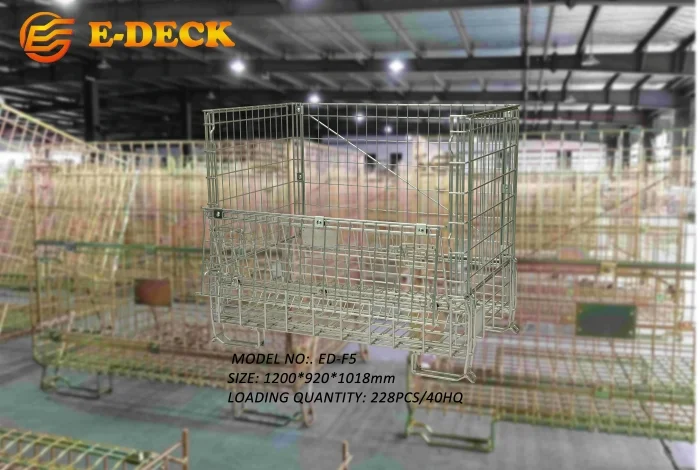
Returnable packaging has become a strategic priority for manufacturers, logistics providers, and retailers seeking to reduce waste, control costs, and improve supply chain efficiency. Unlike single-use cartons or plastic wraps, returnable packaging systems rely on durable, reusable units that circulate continuously between suppliers, production plants, distribution centers, and end users. In this context, foldable wire container options have emerged as a highly practical solution, combining strength with space efficiency.
Understanding Returnable Packaging
Returnable packaging refers to transport packaging that is designed for multiple use cycles rather than one-time disposal. Typical examples include pallets, crates, bins, and industrial containers that move back and forth between stakeholders. These assets are part of a closed-loop or reverse logistics system, where empty packaging is collected, returned, cleaned if required, and redeployed.
The success of such systems depends heavily on the packaging medium itself. It must be durable, stackable, easy to handle, and economical to store and transport when empty. This is where collapsible wire containers create a strong operational advantage.
Space Optimization Through Collapsibility
One of the most important challenges in returnable packaging is the cost of transporting and storing empty containers. A foldable wire container addresses this issue directly by collapsing into a fraction of its loaded height when not in use. This reduces the number of truckloads required for reverse logistics and significantly lowers warehousing space requirements for idle assets.
By minimizing the volume of empty returns, organizations can improve trailer utilization, reduce fuel consumption, and streamline backhaul operations. Over time, these efficiencies translate into meaningful logistics cost savings.
High Durability for Long Lifecycle Use
Returnable packaging must withstand repeated handling, stacking, forklift movements, and long-distance transport. A well-designed steel wire container provides the structural strength required for such demanding cycles. Its rigid frame resists deformation, while the welded mesh construction protects goods without adding excessive weight.
This durability ensures that containers remain serviceable for years, supporting hundreds of rotation cycles. As a result, the cost per trip declines steadily over the asset’s lifecycle, improving the overall return on investment.
Hygiene, Ventilation, and Product Protection
In industries such as food processing, agriculture, and pharmaceuticals, hygiene and airflow are critical. A steel wire container allows excellent ventilation, preventing moisture buildup and reducing the risk of mold or odor formation. The open mesh structure also makes it easy to visually inspect contents without opening or unstacking units.
Additionally, smooth metal surfaces are easy to clean and disinfect, making these containers well suited for closed-loop packaging programs that demand high sanitation standards.
Improved Warehouse and Handling Efficiency
Within distribution centers and manufacturing plants, container design has a direct impact on material flow. A wire container for warehouse operations offers clear visibility of stored items, faster picking, and easier inventory control. Workers can quickly identify product types and quantities without opening sealed packaging.
These containers are typically compatible with forklifts, pallet jacks, and automated handling systems, enabling seamless integration into existing warehouse infrastructure.
Support for Reverse Logistics and Tracking
Returnable packaging systems depend on effective reverse logistics. A wire container for warehouse circulation is easier to track, stack, and stage for return shipments. Many organizations integrate barcode labels, RFID tags, or asset ID plates onto wire containers to monitor movement, cycle counts, and asset location.
This visibility reduces container loss, improves accountability across supply chain partners, and ensures that assets are available when needed.
Handling Heavy or High-Value Loads
For especially heavy or dense goods, companies often require reinforced packaging units. A steel stillage container provides higher load-bearing capacity and rigid sidewalls, making it suitable for automotive components, metal parts, and industrial assemblies.
These containers can be stacked safely in multi-tier storage configurations, maximizing vertical space utilization while maintaining load stability.
Conclusion
Returnable packaging is no longer just a sustainability initiative; it is a core operational strategy for efficient and resilient supply chains. By combining durability, collapsibility, hygiene, and handling efficiency, wire-based industrial containers provide an ideal foundation for closed-loop logistics.
When implemented correctly, these containers help organizations reduce costs, improve asset utilization, enhance environmental performance, and streamline both forward and reverse logistics operations.